Going Live with PayPlan: User Acceptance Testing
Audience: System Administrators, Operations Leads, & Chief Lending Officers (Core, Pro, Enterprise)
Topic: User Acceptance Testing (UAT) & Deployment Lifecycle
Overview
Because PayPlan functions as the financial ledger and operational core of your lending business, deploying your environment requires rigorous validation. While the underlying technology is battle-tested, the complexity of your specific rules, products, and risk models dictates a structured Collaborative UAT Process.
This 6-week protocol applies to our three advanced deployment tracks:
-
Core (Advanced Configuration): A highly robust setup that introduces advanced financial products like installment loans. This track leverages sophisticated configurations rather than custom engineering, delivering power without the wait time of custom development.
-
Pro (Targeted Customization): This track includes bespoke Figma design creation, dialed-in operational requirements, and custom development for 1-2 specialized features or targeted API access.
-
Enterprise (Ecosystem Engineering): Our tier built for high-volume institutional lenders. This track involves deep architectural integrations and 3+ custom-engineered features designed for absolute scale.
Regardless of your track, deploying a bespoke financial ledger requires absolute precision. This structured protocol is designed to eliminate moving targets and ensure your system is stable, secure, and perfectly calibrated before it handles a single live dollar.
1. The Co-Testing Advantage: Speed Without Compromise
Launching a bespoke financial ledger requires absolute precision, but that should not come at the expense of your deployment timeline. Traditional software hand-offs often isolate the client, throwing the build "over the fence" and forcing your operations team to act as the sole quality assurance department. This creates bottlenecks and delayed launches.
At PayPlan, we enforce a strategy of Parallel Co-Testing. We do not simply deliver your Sandbox environment and wait for you to report issues; our Product and Engineering teams test alongside you in real-time.
Operational Validation (Your Team): Your team focuses entirely on business value, verifying that your custom underwriting workflows, dynamic document generation, and borrower-facing experiences map perfectly to your operational goals.
Systemic Validation (Our Team): While you test the front-end, our engineers are simultaneously monitoring the architecture—validating API payloads, auditing automated Decision Engine logs, and verifying ledger calculation accuracy.
The Result: By testing in parallel, we dramatically compress the feedback loop. If your team encounters a workflow exception, our team is already looking at the same systemic data to trace the root cause. This collaborative approach guarantees that your lending ecosystem is rigorously battle-tested for reliability, while fiercely protecting your 6-week Go-Live schedule.
Tip: Use the Magic Link feature in the Admin Portal during your walk-through to see the exact application screen from the borrower's perspective.
2. The Deployment Lifecycle (The 6-Week Path)
The journey from a completed build to a live Production environment follows a mandatory 6-week schedule. This phased approach guarantees that your team has adequate time to test complex lending logic, and our Product Team has dedicated windows to refine the platform without disrupting your workflow.
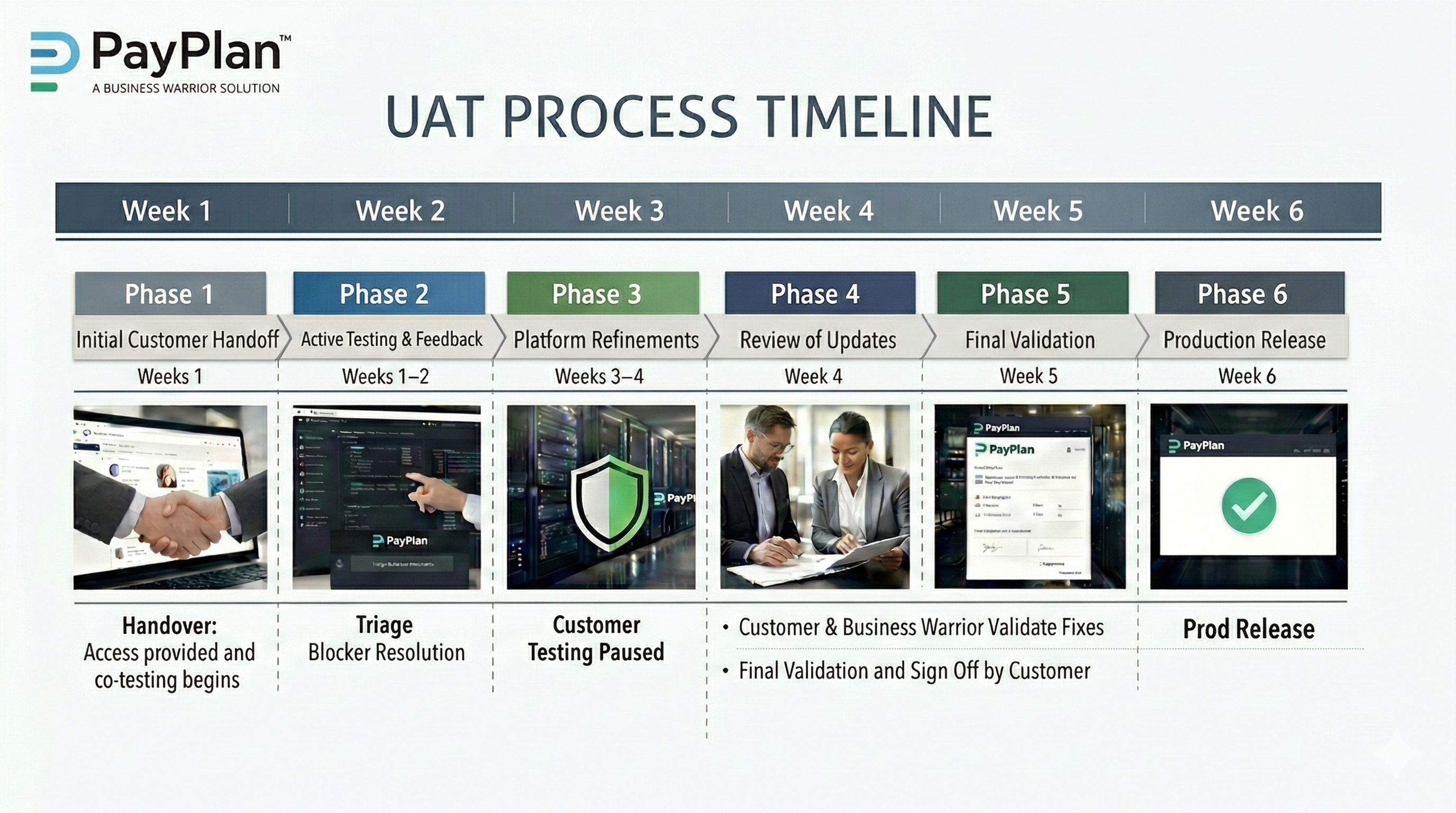
|
Phase |
Activity |
Schedule |
Milestone |
|
Phase 1 |
Initial hand-off for co-testing |
Day 1 |
System walk-through and Sandbox environment delivery. |
|
Phase 2 |
Active Testing & Feedback |
Weeks 1–2 |
Your team actively tests workflows; Our team will address immediate resolution for critical blockers. |
|
Phase 3 |
Platform Refinements |
Weeks 3–4 |
"Pencils Down" for testing; Our team internally processes requested adjustments. If there is a larger scope of work identified, we will discuss with you on the options. |
|
Phase 4 |
Review of Updates |
Week 5 (Early) |
Customer testing resumes to verify all batched system refinements. |
|
Phase 5 |
Final Validation |
Week 5 (Late) |
Formal written approval from your leadership team. |
|
Phase 6 |
Production Release |
Week 6 |
Production deployment and official Go-Live. |
3. Your Central Command: The Service Desk
To maintain a single source of truth and a flawless compliance audit trail, all feedback, system adjustments, and inquiries must be logged through the Business Warrior Service Desk. Relying on emails, phone calls, or chat messages creates a fragmented chain of custody and introduces unnecessary risk to your launch timeline.
Ticket Stage Definitions
Understanding the status of your requests is critical to tracking your Go-Live readiness. When you view your Service Desk portal, your tickets will be categorized as follows:
-
Waiting for Customer: Our team requires additional clarification, a specific Application ID, or a screenshot from your team to proceed.
-
In Progress: Our engineering team is actively coding an immediate fix (strictly reserved for catastrophic "Blockers" during active testing).
-
Escalated: A critical workflow failure that has bypassed standard triage for immediate executive evaluation.
-
Pending: Your request has been verified and successfully locked into the Phase 3 "Platform Refinements" batch.
-
Product Backlog: A request categorized as a new feature, custom scorecard adjustment, or enhancement, which will be scoped for a future, post-launch sprint.
-
Resolved: The refinement has been deployed to your Sandbox and is ready for your team to verify during Phase 4.
4. Triage Strategy: Blockers vs. Batches
To protect the stability of your testing environment, PayPlan categorizes every piece of feedback into one of two precise resolution paths:
A. The Blocker Protocol (Immediate Action)
A "Blocker" is a critical issue that completely prevents your team from validating a core workflow (e.g., your automated Decision Engine logic is failing to trigger, or a configured third-party integration is not returning data).
-
Action: These are immediately moved to Escalated or In Progress.
-
Resolution: Our engineering team commits to a 1–3 business day turnaround to deploy a hotfix and unblock your workflow.
B. The Batch Protocol (Structured Resolution)
Non-blocking items—such as UI adjustments, dynamic document template updates, or reporting tweaks—are moved to Pending.
-
Action: These items are securely logged but are not deployed daily. Instead, they are bundled into a single deployment during Phase 3 (Platform Refinements).
-
The Value: Pushing constant adjustments while your team is actively testing creates a frustrating and unstable environment. Batching ensures that when we hand the system back for your Review of Updates (Phase 4), the ecosystem is cohesive, polished, and fully functional.
5. The Weekly Alignment Routine
To ensure total transparency and protect your launch date, your Account Manager will conduct a weekly cadence call to review your Service Desk board.
During these working sessions, we will:
-
Share the Board: Review your specific portal view live.
-
Review Blockers: Provide exact delivery windows for any In Progress system resolutions.
-
Validate the Batch: Review all Pending items to guarantee no operational feedback has been missed or miscategorized.
Clear the Queue: Address any Waiting for Customer items live on the call to keep your deployment timeline moving.
6. Final Sign-Off & Financial Integrity
Because PayPlan functions as the system of record for your lending portfolio, launch is only authorized once formal written approval is received from your leadership at the conclusion of Phase 5 (Final Validation).
Once this sign-off is securely recorded, your Sandbox build is locked. Our Product Team then authorizes Phase 6: Production Release. Any lingering, non-critical enhancement requests will be safely moved to your post-launch Product Backlog to ensure your Go-Live date remains secure and your financial operations can begin with confidence.